ASIA GULF PARTNERS
Navigating the nexus of government vision and business ambition.
We deliver bespoke strategies that align public and private sector priorities to achieve tangible results.
political intelligence | policy advocacy
market access | stakeholder relations
transaction support
Damian Hickey
Managing Director
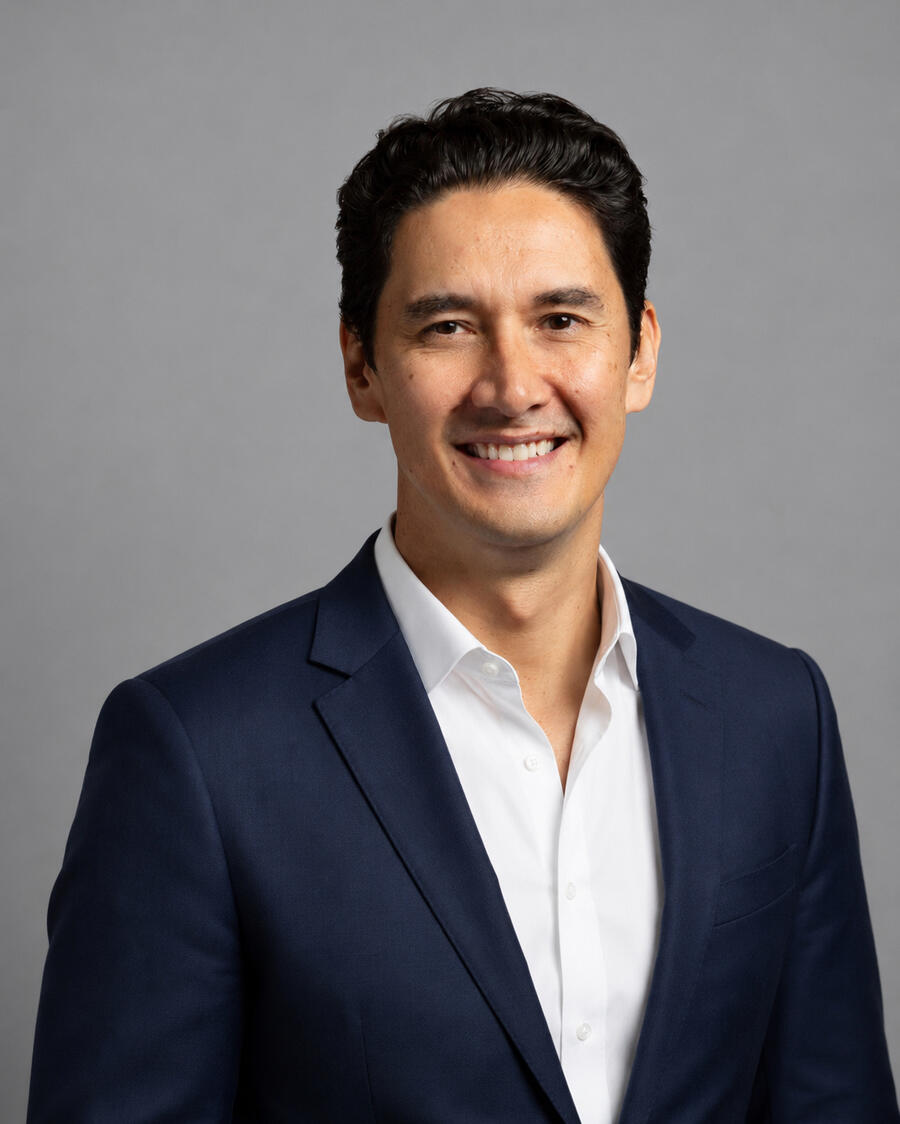
Damian brings over 20 years of experience in public policy, government relations and strategic advisory across Asia and the Middle East. He has been a trusted advisor to senior political leaders, worked closely with ministers and government agencies, and built deep networks across government, business and policy communities.As Regional Director for Southeast Asia at the Tony Blair Institute for Global Change, Damian led multidisciplinary teams providing policy and strategic communications advice to the presidents of Indonesia, the Philippines and Timor-Leste, and the Prime Minister of Vietnam. He worked with national leaders, ministers and implementing agencies on economic development and investment attraction, digital trade and AI governance, energy security, and foreign policy.As Deputy Chief of Staff and Head of Policy to the Australian Deputy Prime Minister and Minister for Defence, Damian helped shape and manage major defence strategy, policy and procurement decisions through Cabinet, the National Security Committee and budget processes. His work included the Australian Government’s National Defence Statement, the 2023 Defence Strategic Review and Australia’s acquisition of nuclear-powered submarines under AUKUS.Damian has lived and worked in Asia and the Middle East as a diplomat and consultant for over a decade. In the Gulf, he worked with ministers, government agencies and state-owned enterprises on investment implementation, crisis management and strategic partnerships with Asia.He has also held key roles in the Australian foreign service and ministerial offices focused on trade, foreign affairs and economic engagement with Asia and the Gulf Cooperation Council. He drove initiatives to deepen government engagement with business, helped devise and implement Australia’s economic diplomacy policy through embassies in Asia and the Middle East, and led Australia’s bilateral and ASEAN trade agenda at the Australian High Commission in Malaysia.Having been in the room when major decisions are made, Damian understands how governments think, how issues are framed and how policy moves from political intent to implementation. He applies this experience to help businesses, investors and institutions anticipate government priorities, navigate political and regulatory complexity, and align their strategic objectives with government agendas.
political intelligence | policy advocacy
market access | stakeholder relations
transaction support
Our mission
Asia Gulf Partners was founded on the belief that the Asia-Gulf corridor represents one of the world’s most significant emerging growth opportunities. It connects the Gulf’s capital, energy resources and ambitious national transformation agendas with Asia’s scale, technology, industrial capability and expanding markets.What makes this corridor distinctive is the central role of government. National development plans, sovereign investment, state-owned enterprises, regulation and political relationships all shape commercial outcomes. Realising the corridor’s potential therefore requires closer alignment between government priorities and the ambitions of businesses, investors and institutions.Our mission is to help organisations across Asia and the Gulf better engage and align with governments to achieve tangible and sustainable results.We provide bespoke, outcome-led support—from actionable political and regulatory intelligence that informs operational and investment decisions, to the design and implementation of delivery-based government engagement strategies that generate commercial impact.
political intelligence | policy advocacy
market access | stakeholder relations
transaction support
Insights
political intelligence | policy advocacy
market access | stakeholder relations
transaction support

political intelligence | policy advocacy
market access | stakeholder relations
transaction support
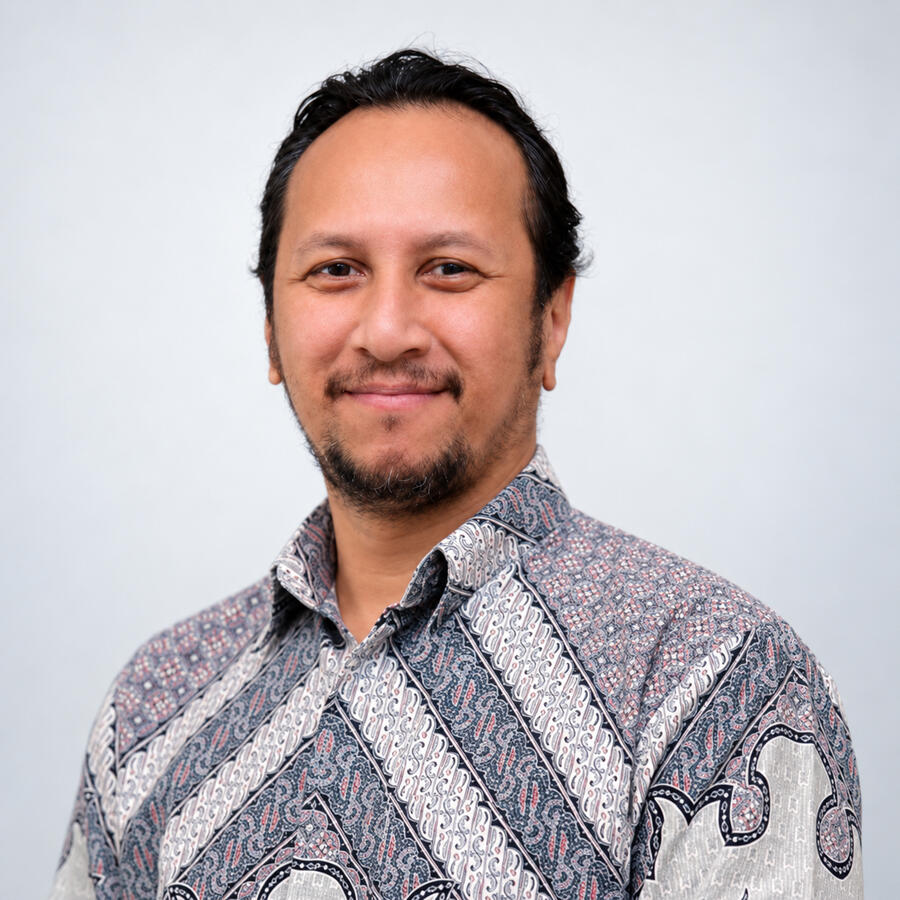
Dr Muhammed Abdul Khalid
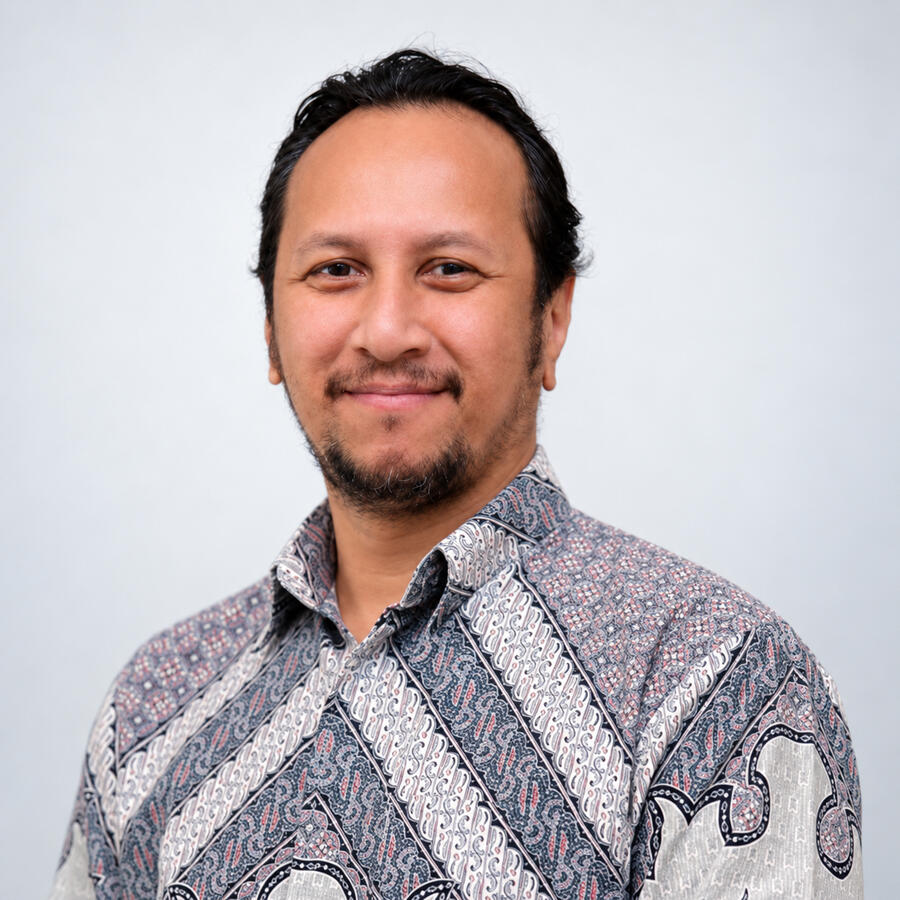
Dr Muhammed Abdul Khalid is a Malaysian economist and public policy adviser with experience across government, business and academia. He understands how priorities, institutions and markets shape policy and outcomes in Malaysia and Southeast Asia.Muhammed is an Adjunct Professor at the Ungku Aziz Centre, Universiti Malaya, and a Research Fellow at IKMAS, Universiti Kebangsaan Malaysia. He is also a Fellow at the World Inequality Lab, Paris School of Economics, and a Senior Associate at the Malaysian Industry Government Group for High Technology.He chairs Allianz General Insurance Company (Malaysia) Berhad, sits on the Board of Allianz Malaysia Berhad and serves on the Economic Committee of the Malaysia Competition Commission.From 2018 to 2020, Muhammed served as Economic Adviser to the Prime Minister of Malaysia and as a member of the Economic Action Council. He previously headed the secretariat of the Council of Eminent Persons, established after Malaysia’s 2018 election to advise the government on economic and financial policy.Earlier positions include Director of Research at the Khazanah Research Institute, Head of Economics at the Securities Commission Malaysia and Senior Technical Adviser at UNDP Malaysia. He has advised multinational corporations and consulted for the World Bank, Asian Development Bank and United Nations agencies.Muhammed holds a PhD and Master of Public Affairs from Sciences Po Paris, a Master of Economics from Universiti Malaya and a Bachelor of Science from the University of Southern California.Muhammed helps leaders navigate complexity, align strategies with government priorities and translate economic ambition into sustainable outcomes.
political intelligence | policy advocacy
market access | stakeholder relations
transaction support
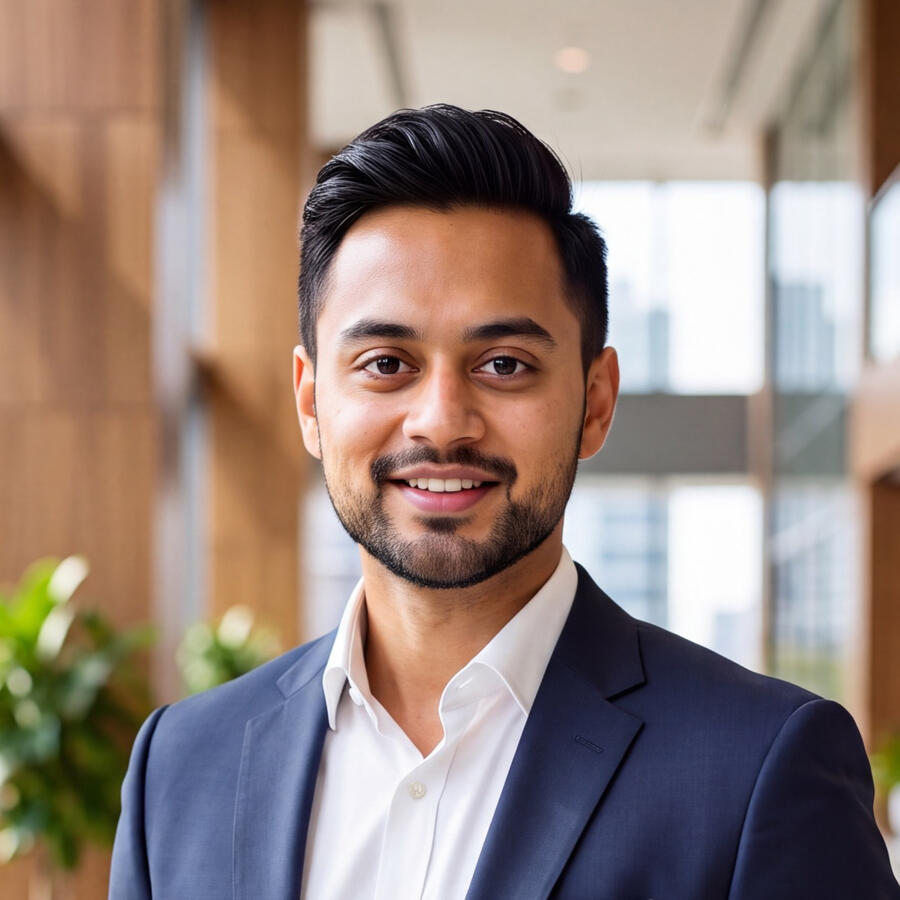
Sameer Anwar
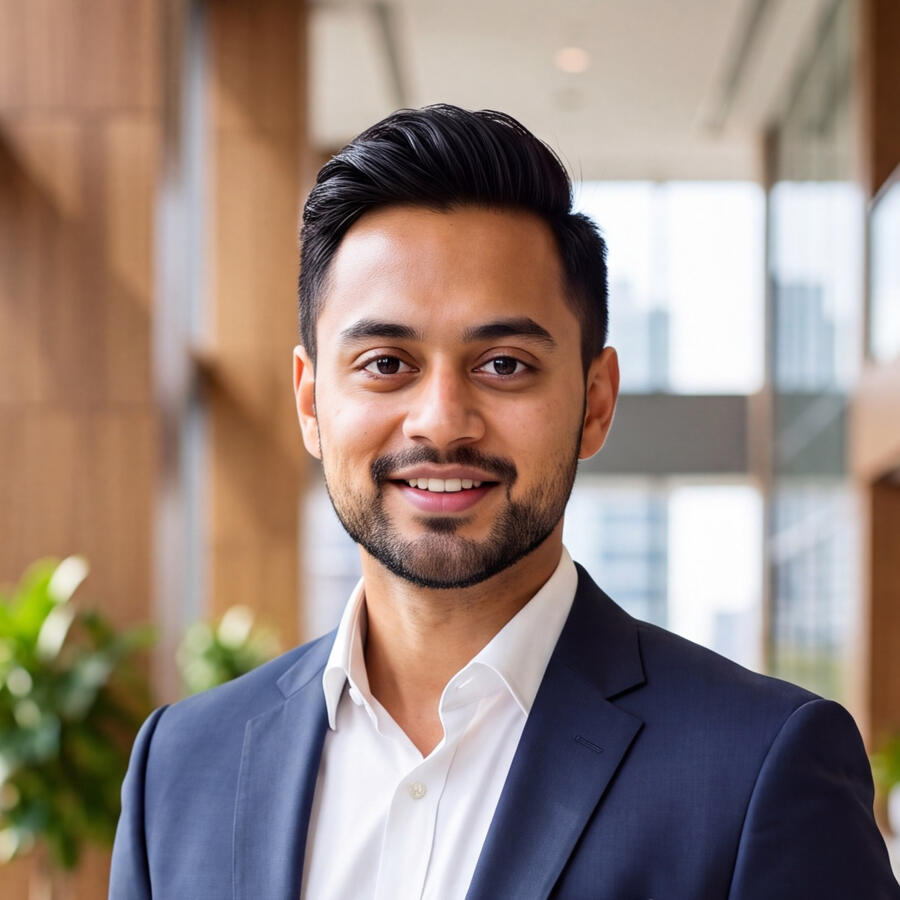
Sameer is a senior delivery expert with over 17 years of experience advising governments, Fortune 500 chief executives and philanthropic organisations on strategy and implementation. He has advised more than 30 governments and heads of state across Asia, the Middle East and North America, helping leaders translate priorities into measurable results.At the Tony Blair Institute for Global Change and Delivery Associates, Sameer helped advance the theory and application of government delivery units. He led the development of delivery units and large-scale capability building programmes.His experience includes establishing centres of government, setting strategy, improving public service capabilities, leading digital transformation and operationalising delivery mechanisms that strengthen accountability, coordination and problem solving. He has also contributed to initiatives supporting some of the world’s largest education and health reforms.Sameer previously served as Head of the Middle East and South Asia at Delivery Associates and as a Senior Adviser at the Tony Blair Institute. Earlier, as a consultant in Bain & Company’s public sector practice, he advised clients across the Middle East and South Asia.His private sector experience includes serving as Vice President for Strategy, Finance and Data at Trove, a Silicon Valley technology platform. He began his career in investment banking and corporate finance with JPMorgan in New York and KPMG in Toronto.Having worked across government delivery, management consulting, technology and finance, Sameer understands both the institutional and commercial dimensions of execution. He applies this experience to help governments, businesses and institutions establish priorities, build delivery systems and turn strategy into measurable impact.
political intelligence | policy advocacy
market access | stakeholder relations
transaction support
Steven Derek Brown

Steven brings over 25 years of experience in capital markets, corporate advisory and institutional finance, and is an Australia, Asia and Vietnam specialist. He has advised listed and unlisted companies and investors on capital raising, market entry, mergers and acquisitions, equity and debt structuring, IPO preparation, corporate governance and business growth.Steven has spent over a decade in senior leadership roles in Vietnam’s securities industry. As Director and Head of Institutional Sales and Trading at VPS Securities, Vietnam’s largest brokerage by market share, he reported directly to the Chairman. At Mirae Asset Securities, he was Director and Head of Institutional sales, and held senior management roles at SSI Securities and Viet Capital Securities.Prior to Vietnam, Steven was a client adviser with Citigroup in Australia, where he personally managed more than $500 million in assets, and an analyst and adviser with Bell Potter Securities.He has helped establish UCITS and SIF (EU compliant) investment funds and advised companies on investor relations, roadshows, corporate access and transaction execution. A major market entry project included advising Shinhan (Korea) on its market entry and establishment of securities brokerage operations in Vietnam.Steven serves as Corporate Strategy Adviser to the Board of Queensland Wool, supporting Vietnam and Singapore market entry. His leadership experience includes Vice Chairman roles with the British Chamber of Commerce Vietnam, the Vietnam Independent Directors Association, VinUniversity and the Australia-Vietnam Business Council. He is on the Advisory board of VinUniversity, and is a Professor of Practice in VinUniversity’s MBA programme.Having built relationships across corporations, financial institutions, sovereign investors and global private capital, Steven understands how transactions move from intent to investor engagement and execution. He helps businesses and investors assess opportunities, structure credible propositions, access decision makers and mobilise capital across Vietnam and Asia.
political intelligence | policy advocacy
market access | stakeholder relations
transaction support
GCC-ASEAN investment alignment screen: August 2026
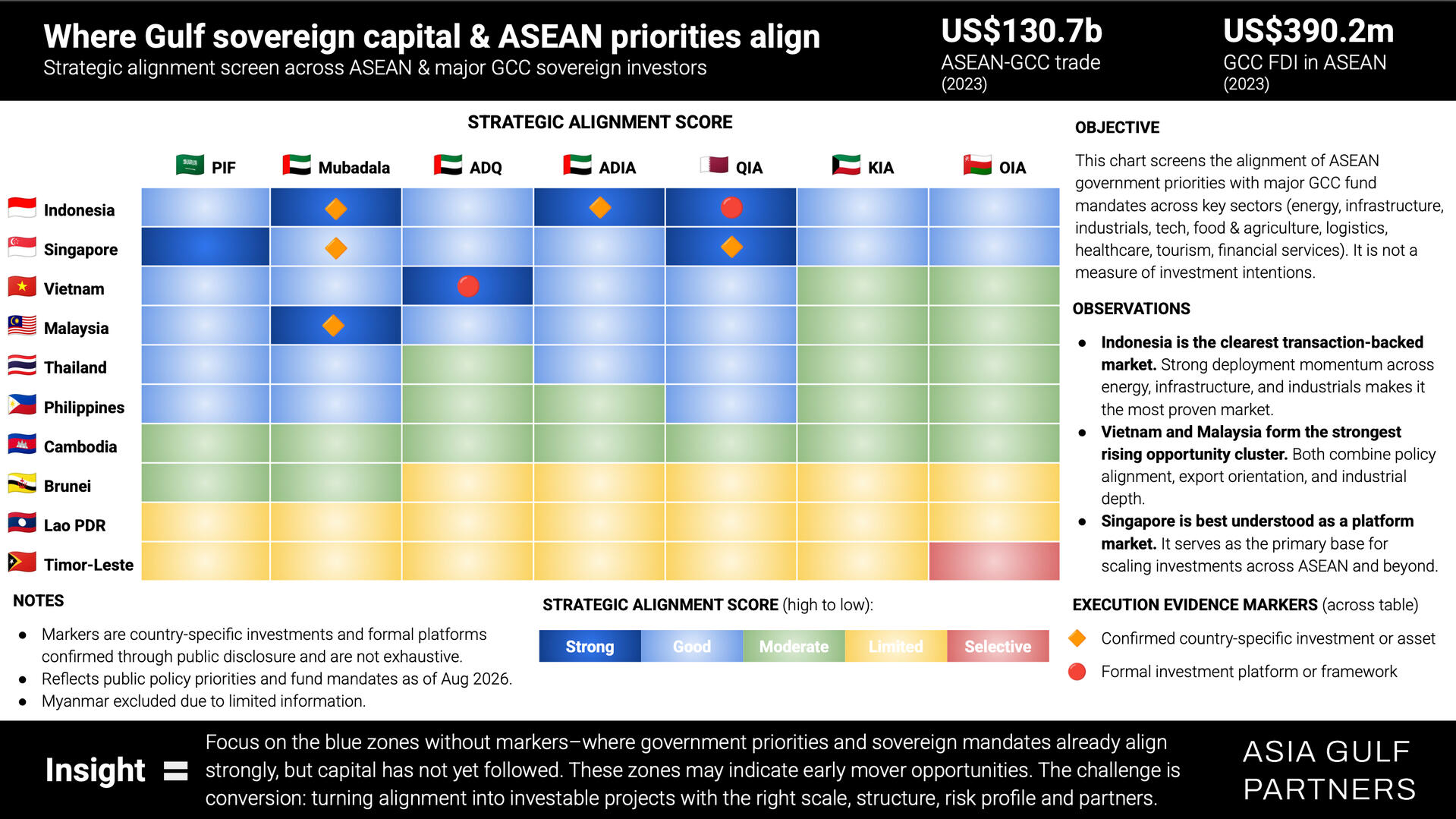
This assessment is a directional analytical screen developed by Asia Gulf Partners to identify where the stated economic and investment priorities of ASEAN governments most closely align with the mandates of major Gulf sovereign investors.The assessment covers ten ASEAN markets and seven major GCC sovereign funds: Saudi Arabia’s Public Investment Fund (PIF); Mubadala Investment Company, ADQ and Abu Dhabi Investment Authority (ADIA) from the UAE; Qatar Investment Authority (QIA); Kuwait Investment Authority (KIA); and Oman Investment Authority (OIA).The analysis covers sectors including energy, infrastructure, industrials, technology, food and agriculture, logistics, healthcare, tourism and financial services.Each country–fund pairing was assessed against two principal questions:ASEAN government priorities: What sectors, capabilities and forms of investment does the government explicitly prioritise through national development strategies, industrial policies, investment plans, economic transformation programs and official investment promotion materials?Sovereign investor mandates: Where does each Gulf sovereign investor have an identifiable mandate, investment strategy or demonstrated sectoral appetite that corresponds with those priorities?The assessment focuses on the intersection between these two sets of priorities, rather than simply measuring the attractiveness of an ASEAN economy or the size of a Gulf fund.Alignment was classified into five qualitative categories:Strong – substantial overlap across multiple strategically important sectors, with a particularly clear fit between government priorities and the fund's mandateGood – meaningful alignment across several priority areas, although the fit is less comprehensive than in Strong relationshipsModerate – identifiable areas of alignment, but either narrower in scope or less central to the respective strategiesLimited – relatively few clear areas of strategic overlap based on publicly available informationSelective – a narrow but identifiable strategic fit in specific sectors or opportunities rather than broad-based alignmentThese categories are deliberately directional rather than numerical. They reflect comparative analytical judgement based on publicly stated priorities and mandates; they are not forecasts of investment flows, expected returns or future fund intentions.A central feature of the methodology is the distinction between strategic alignment and actual execution. A high alignment assessment does not mean that significant sovereign capital has already been deployed. Conversely, an existing investment does not automatically imply broad strategic alignment.The chart therefore overlays a separate execution-evidence layer using two markers:Confirmed country-specific investment or asset – used where public disclosure provides evidence of a sovereign investor having deployed capital into an identifiable investment or operating asset in that ASEAN market.Formal investment platform or framework – used where a sovereign investor has entered a formal country-specific investment platform, co-investment vehicle or comparable institutional framework.Evidence is applied conservatively. General diplomatic agreements, government-to-government MoUs or investments in globally diversified companies are not treated as country-specific sovereign investment unless a clear connection to the relevant ASEAN market can be established.The execution markers are therefore illustrative rather than exhaustive. Some sovereign investors, particularly ADIA, KIA and OIA, provide limited public disclosure at country level, meaning additional exposure may exist that cannot be independently verified from public sources.The assessment also considers the broader architecture supporting ASEAN-GCC economic integration, including bilateral and regional trade agreements, investment frameworks and formal economic cooperation mechanisms.These arrangements can strengthen the enabling environment for investment, but they are not themselves treated as evidence of sovereign capital deployment. Their relevance is instead reflected where appropriate in the assessment of strategic and institutional alignment.The analysis draws primarily on publicly available sources, including: national development plans and economic strategies; government investment and industrial policies; sovereign wealth fund strategies, annual reports and official websites; official government and sovereign-fund announcements; publicly disclosed transactions and investment platforms; ASEAN and GCC economic cooperation documents; and bilateral trade and investment agreements.Where evidence was ambiguous, the assessment adopted the more conservative classification.The framework is designed to highlight potential conversion gaps: areas where ASEAN government priorities and Gulf sovereign investor mandates already appear strongly aligned, but publicly visible capital deployment remains limited.These areas may warrant deeper analysis of project scale, commercial structure, risk allocation, counterparties, regulatory requirements and investment readiness.The assessment is not an investment ranking, country risk assessment or prediction of future sovereign investment. It should be read as a strategic screen indicating where policy priorities and investment mandates appear most closely aligned based on information available as of August 2026.
political intelligence | policy advocacy
market access | stakeholder relations
transaction support
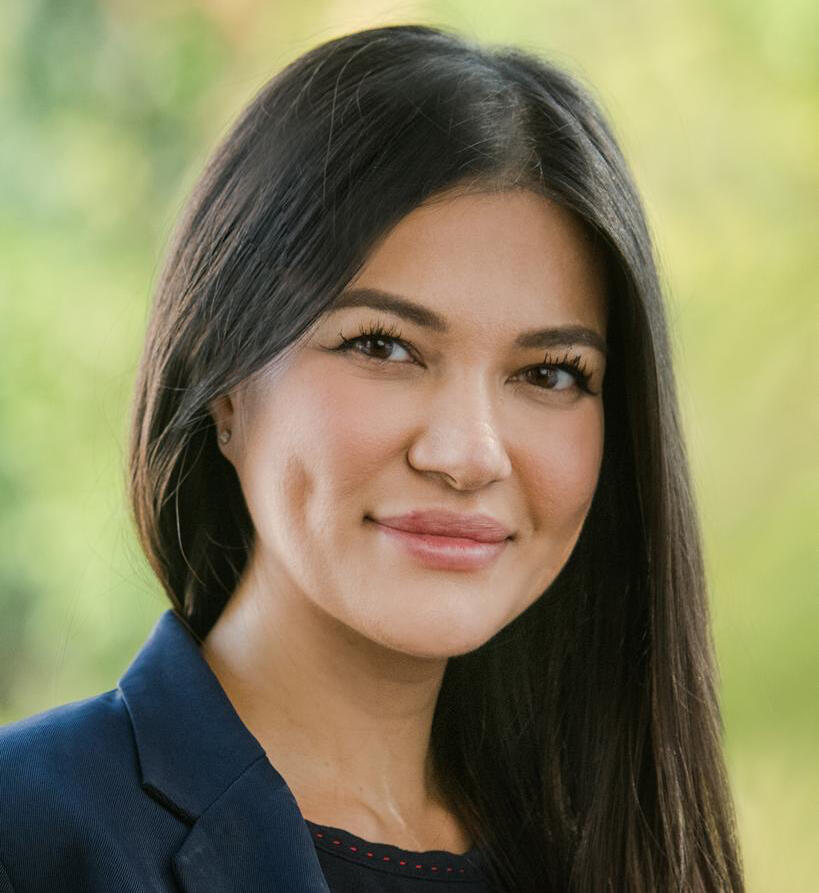
Fatima Almubbad
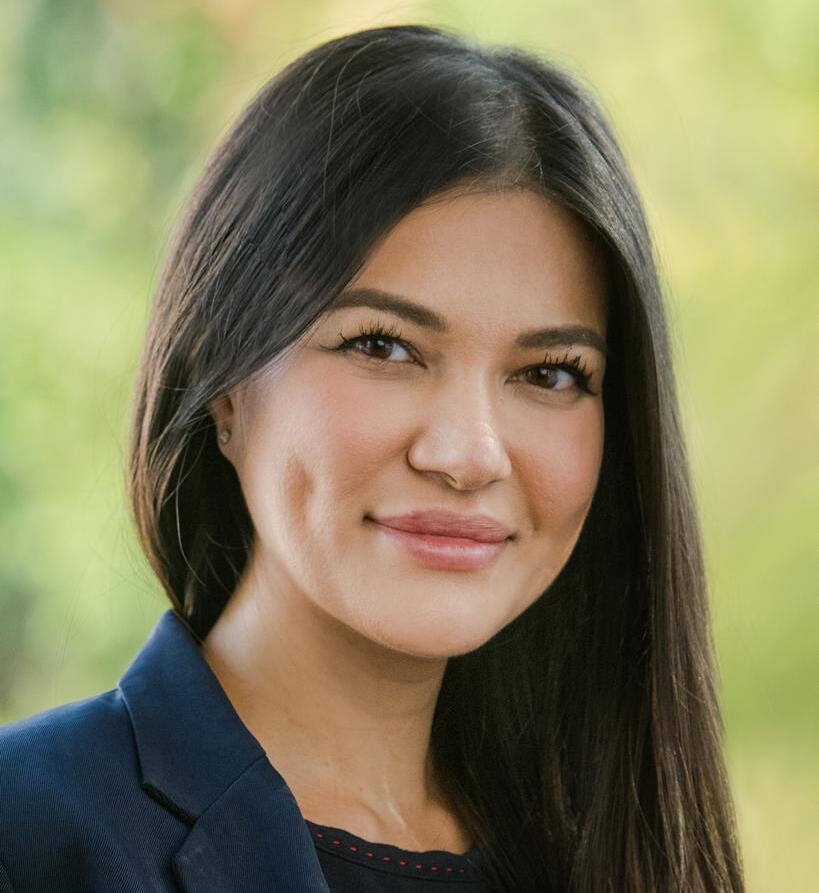
Fatima is a senior investment and government relations executive with over 20 years of experience advancing government, business and diplomatic engagement across Asia, the Middle East and Europe. She specialises in cross-border investment, public private partnerships and sovereign aligned capital deployment, helping connect private sector capabilities with government economic, industrial and digital transformation priorities.Throughout her career, Fatima has led business-to-government and government-to-government initiatives that have supported substantial foreign direct investment, multinational expansion and bilateral economic cooperation. She has helped secure hundreds of millions of dollars in investment commitments, expand regional trade portfolios and shape high-level and ministerial agreements across sectors including fintech, digital assets, advanced manufacturing and real estate.Her experience spans investment strategy, risk governance, public sector stakeholder management and the structuring of complex public-private partnerships. She has also supported government-level capital frameworks designed to align institutional investment with national development objectives. Working across diverse institutional and cultural environments, she combines policy alignment with commercial strategy to translate government priorities and private sector ambition into investable, scalable opportunities.Fatima is a graduate of the London School of Economics and is fluent in English, Mandarin and Arabic. Her international experience and cultural fluency allow her to operate effectively across markets and engage senior government, institutional and corporate stakeholders.Having worked at the intersection of capital, policy and international economic engagement, Fatima understands how government priorities shape investment decisions and commercial outcomes. She helps businesses, investors and institutions build credible partnerships, navigate complex stakeholder environments and convert cross-border ambition into sustainable growth.
political intelligence | policy advocacy
market access | stakeholder relations
transaction support